S. Stoop

For necks that hurt by Wednesday.

Your back knows before the mirror.

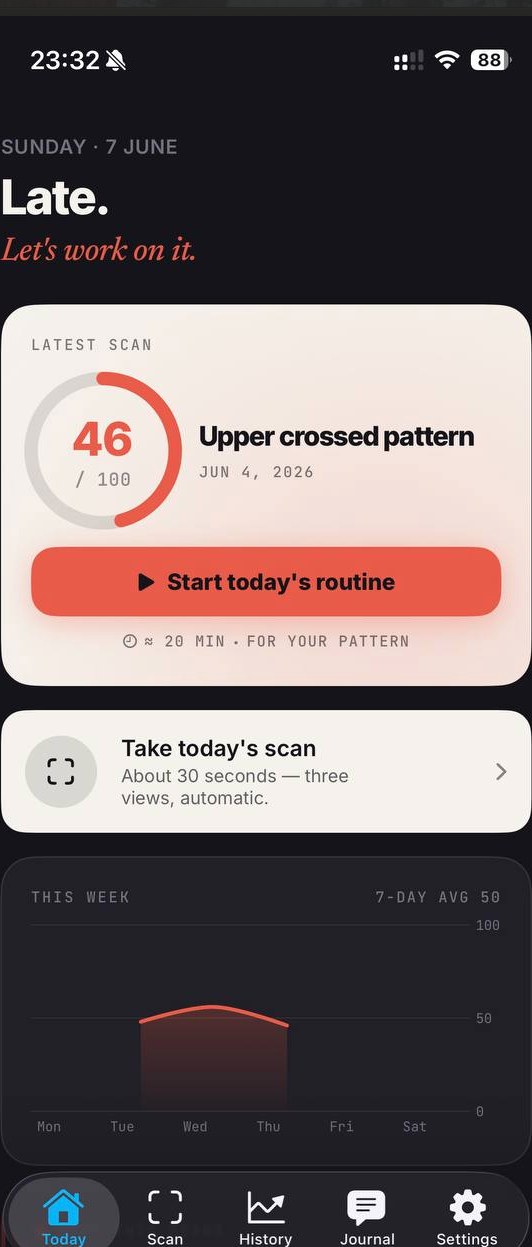
Thirty seconds with the camera and you see where your back has drifted. A short journal explains why — long Zoom day, bad night, that one chair. Then five minutes of exercises built for your particular shape, not the average one.

Coming soon to App Store See how it works ↓

Seven days free to try. Six native languages.

Stoop today screen with posture score and the day's adaptive routine

Photos never leave your phone  ·  No ads, ever  ·  No account needed  ·  Six native languages

How it works

Three inputs.
One honest read.

A coach that remembers your week — not an app that flashes a number and leaves.

01

The 30-second scan

Prop the phone. Step back. Hold still. Apple Vision finds your joints on-device — head, shoulders, hips, ankles. The frames die in RAM the moment the math is done. You keep the numbers. Nobody keeps the photo.

Frames never leave the phone.
02

The 30-second journal

One line a day. "Six hours of Zoom." "Slept like garbage." "Carried the toddler again." Pick from 12 tags or type your own. After about 5 entries and 5 scans, the boring stuff starts pointing at the painful stuff.

Thirty seconds. That's the ask.

03

The 5-minute routine

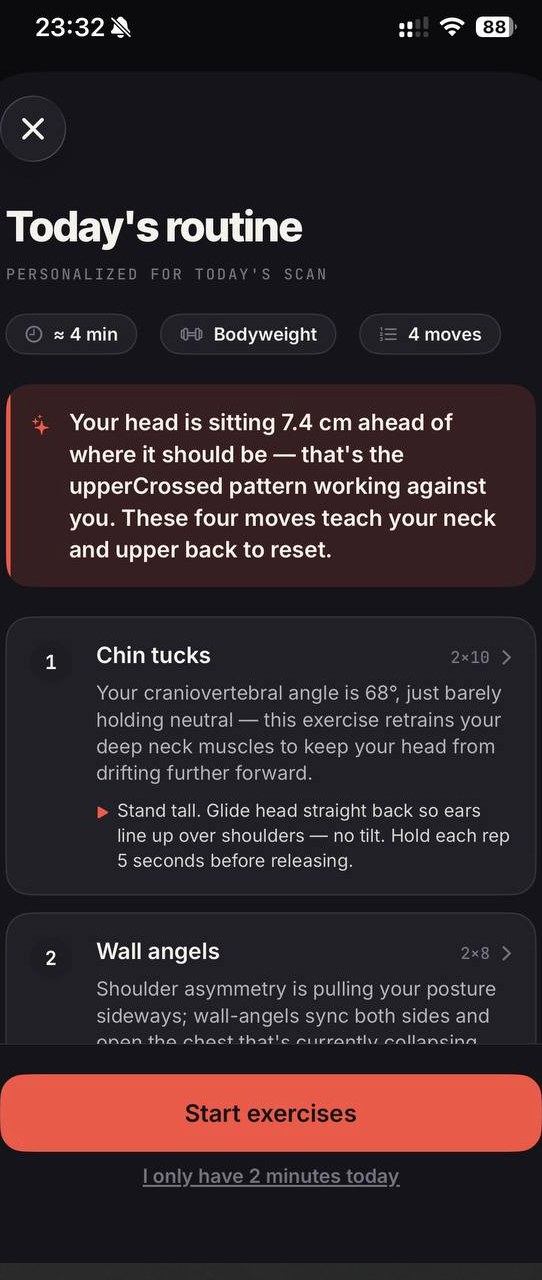
34 physio-grade moves in the library. Stoop picks 3 to 5 for what your back is doing this week — forward head, shoulder lean, pelvic tilt. A voice reads each one so you can look away from the screen. Spotify keeps playing.

Your music never pauses.

AI engine

The boring part
AI is good at:
spotting what repeats.

Other posture apps show a score and walk away. Stoop watches what repeats — your Zoom days, your bad nights, that one chair — and turns it into one thing to do today.

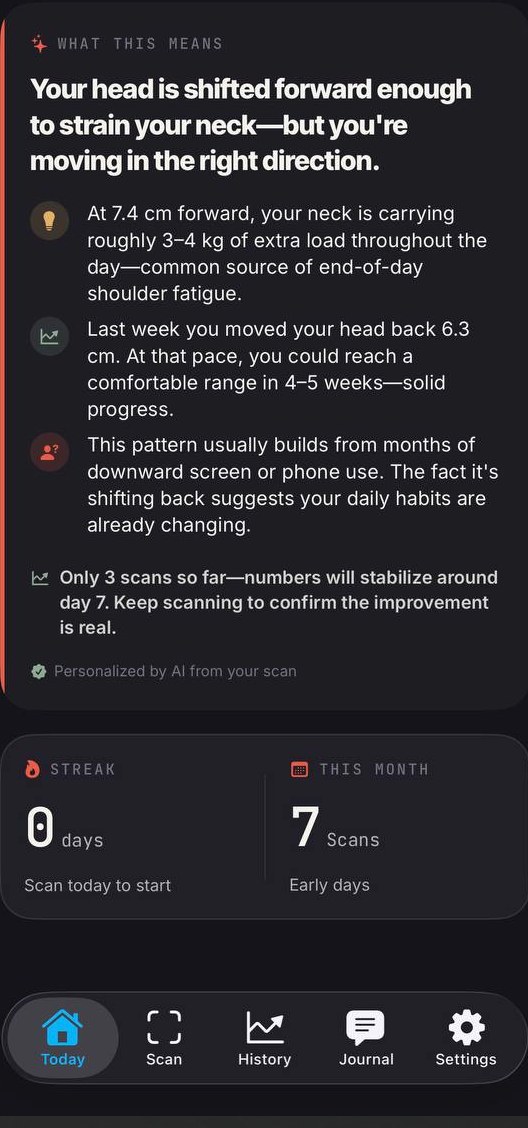
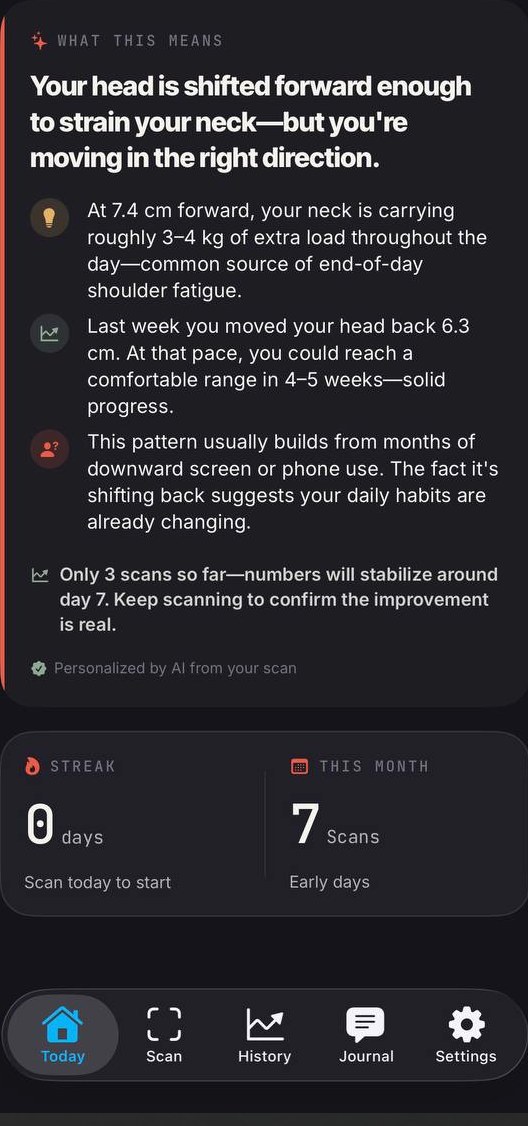
  • Plain language, no Latin. "Your head sits 6 cm forward — about 6 kg of extra weight on your neck, all day." Not "CVA 52°." Not a PDF from 2014. Every line written for a person, in your language.
  • A cause, not just a symptom. Stoop doesn't stop at "forward head." It names the likely upstream culprit — tight chest, weak upper back, the way you sleep on one side — and that's what shapes the session you get today.
  • Connections you'd miss on your own. 12 tags, scanned against your trend. "On «long Zoom» days, your head sits 0.8 cm further forward." That's the sentence. Not "try to exercise more." You already knew that one.
  • A routine for your week, not the average back. From 34 physio-grade moves, the selector pulls 3–5 aimed at whatever's loudest in your scan this week. Each one shows up with a single sentence tied to your last scan — not a generic "good for posture" sticker.
  • A debrief that remembers yesterday. Skipped two days? It notices. On a 6-day streak? It says so once, then moves on. Avoiding the shoulder routine for a week? It gently asks why. A coach without short-term memory is just a stopwatch.
  • A 14-day verdict. No confetti. One sentence under your before/after says whether the shift is real or still noise. No false celebration. No spiral over one bad scan.
  • AI is a toggle. One switch in Settings turns it off. Stoop becomes a clean measurement tool, the Journal stays a private notebook. The model already never sees photos — with AI off, it doesn't see your tags either.
AI insight card: plain-language summary of forward head offset and what it means for daily load

The journal

The part most
posture apps
forgot to build.

"Long Zoom day, neck tight." "Slept on the couch." "Carried the baby on the left again." Two weeks of those lines and Stoop can tell you which habits are wrecking your back and which ones you can stop blaming.

  • Twelve tags, prewritten. Work, sleep, mood, activity, body. Tap, don't type. Free text is welcome — but the tags do the actual work.
  • Patterns show up around day 5. After about 5 entries and 5 scans, you start getting sentences like "on «long Zoom» days, your head sits 0.8 cm further forward." That's the level. Not "exercise more." Not a horoscope.
  • You decide if AI reads it. Flip AI off in Settings and the journal turns back into a private notebook. Nothing gets sent anywhere. No opt-in fine print. No re-prompting you next Tuesday.
Pre-session card with AI rationale for today's chosen routine

The 14-day read

Two weeks later —
one honest sentence.

Two scans side by side show you the direction. One AI-written sentence tells you whether that direction is the real thing or a coin flip.

  • Four arrows. Head, shoulders, hips, ankles. Up, down, or flat. Read it in two seconds. Argue with it for the rest of the day if you want.
  • One sentence, written from your numbers. Not a template. Not a Mad Lib. Small wins get called small. Real wins get named. If nothing moved, it says so.
  • No confetti. No doom. A bad scan gets a plan, not a panic attack. A 6-day streak gets a nod, not fireworks. The whole point is you can trust what it says next time.
14-day before/after compare card with per-axis arrows
"A hunched back isn't laziness.
It's the imprint of your week."

— What Stoop is built on

Pricing

$7.99 a month.
That's the whole pitch.

Seven days to try. Then one tap of a real toggle to stay — no carousel, no "are you sure," no 7 AM notifications begging you to come back.

Privacy, plainly

A hard line,
not a policy page.

Frames never leave your phone.

Apple Vision does the scan on-device. The AI (Anthropic's Claude) only ever sees numbers and tags — never a frame, never a thumbnail, never a "just this once." No cloud upload. No backup. No analytics trail.

No trackers. No ads. Ever.

No analytics SDKs. No Facebook pixel. No Mixpanel. The only outbound traffic goes to Apple (for purchases) and to our private server (for AI text). That's the entire list.

Nothing to mine.

One person built this. There is no growth squad, no BI dashboard, no "anonymized aggregate data" team meeting on Thursdays. Your scans live on your phone. Your journal lives on your phone. That's not a value — it's just the architecture.

Questions, answered

Stuff people
actually email about.

  • Is this a medical device?

    No. Stoop is a posture coach, not a doctor and not a diagnosis. The AI talks about biomechanics, not pathology. If something hurts a lot, or hurts for weeks, see a physio. Stoop will tell you the same — and it pauses routines for 24 hours when you log high pain.

  • Does the camera record me?

    No. Apple Vision finds your joints on the device itself. The frames get processed in memory and tossed. Only the numbers survive. There is no upload, no backup, no replay button. Nothing for a hacker, an ex, or me to leak.

  • Android version?

    Not yet. Stoop leans hard on Apple Vision for on-device joint detection, which is iPhone-only. An Android build means a different model and a different privacy story — and that's a different app, not a port. Planned for later, no date yet.

  • Does it work offline?

    Scans, yes — that's the on-device part. AI text needs the internet, since the language model runs on our private server. Flip AI off in Settings and Stoop becomes a pure measurement tool that works on a plane, in a basement, anywhere.

  • I don't speak English.

    Good. Stoop ships in English, Russian, Spanish, Ukrainian, German, and French on day one. The AI writes directly in your language — not Google-translated from English. Voice cues use the iOS system voice for that locale.

  • How do I cancel?

    Settings → Apple ID → Subscriptions → Stoop → Cancel. Same as every App Store subscription. Cancel inside the 7-day trial and you pay nothing. Cancel after billing and Pro stays on until the period ends. No "wait, here's 50% off" popup. No survey. Just gone.

Five minutes.
See what happens.

Coming to App Store soon. The button below becomes the real download link on launch day.

Coming soon to App Store